

Senator, Impoverished People Know the Real World Better Than You Do
A letter to a politician who mistook struggle for ignorance

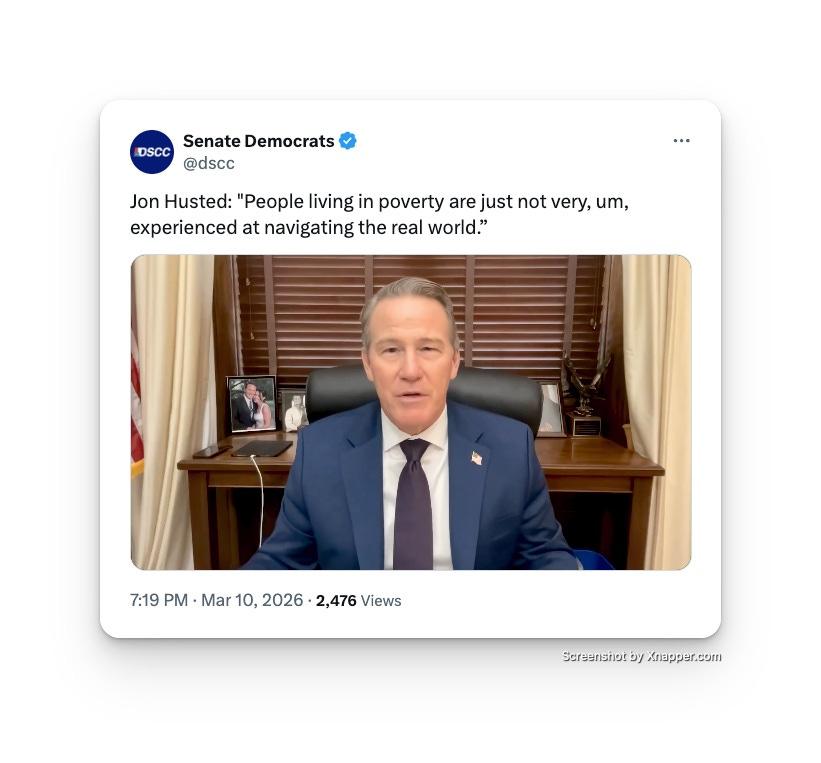
Senator Husted,
I saw the clip where you said that people living in poverty aren’t very experienced at navigating “the real world,” and I thought: That’s a hell of a thing for a United States senator to say about the very people most brutally acquainted with reality.

Let me help.
In terms of practical experience, impoverished people know “the real world” better than most senators ever will.
They know the real world of standing in a grocery line, doing survival math over a cart full of necessities, and a bank “balance” that barely dignifies the word.
They know the real world of working jobs that wear out the body without ever quite paying enough to afford dignity and respect on the regular.
That isn’t inexperience. That, Mr. Husted, is expertise.
Because that’s what it means to live in a country where survival itself requires project management skills, exceptional emotional restraint, and a tolerance for humiliation that nobody should ever have to learn, let alone earn a PhD in.
So no, senator, the problem isn’t that impoverished people don’t know how to navigate the real world.
The problem is that people with salaries, staff, pensions, microphones, and donor networks keep mistaking insulation from the world for wisdom.
You told your story about the young woman who doesn’t know how money works in a grocery store. As though having to use SNAP is somehow evidence that she’s been shielded from reality and can’t quite figure out how money works.
To mistake SNAP for naïveté is to confess how little you understand about the conditions under which millions of people live.
Because SNAP isn’t a retreat from the “real world.” SNAP is what the real world looks like when you can’t find a job that pays anything, the rent’s too high, childcare is almost punitively expensive, and healthcare is a racket where money and attention always flow upward.
And, as if the humiliation is never truly over, the powerful keep offering moral commentary on “bad choices” and non-existent “bootstraps” instead of making the structural changes that could actually fix a few things.
It takes a specially cultivated kind of gall to watch people MacGyver their way through a system engineered to extract time, resources, and dignity from them at every turn … and then conclude that the problem is that they have neither the life experience nor the native wit to grasp reality.
Here’s what makes this particularly hard to stomach: you’ve seen the data, sir. You co-sponsored legislation to protect SNAP funding. You introduced the Upward Mobility Act specifically because you know the benefits structure traps people. You’re not ignorant of how the system works against the people it’s supposed to serve. Which means the young woman in your story wasn’t an argument for your legislation. She was a prop for a podcast audience. That’s worse.
People who’ve had to do without don’t need lectures on reality from people protected from its sharpest edges.
They understand that in this country, a new set of brakes can spiral into a housing crisis. All it takes is one emergency room visit to become a collection notice, followed by a series of debt collectors. One missed shift can turn into a shutoff warning.
And it’s not lost on them that the people who’ve never had to choose between groceries and gas somehow always have the strongest opinions about “personal responsibility.”
That’s the scam, isn’t it?
We build an economy that rewards hoarding at the top, normalizes desperation at the bottom, and then has the audacity to pretend that the people getting screwed by it simply don’t quite have what it takes to master adulthood.
Our culture calls wealthy people “savvy” for exploiting every loophole, tax shelter, and subsidy available to them, but when working families use the assistance programs their taxes helped fund, suddenly everybody is forced to endure lectures about “dependency” and “better budgeting.”
Cute trick, but it’s pretty nasty theology.
Because underneath statements like yours, sir, is an ancient and poisonous lie: that living in hardship demonstrates inferiority, and that if people are suffering economically, there must be something wrong with them. It’s always their fault, rather than something wrong with the arrangements under which they’re being made to live.
That lie is older than capitalism. It dressed itself in the language of Providence when it needed to, in Social Darwinism when that became fashionable, and now it wears the respectable clothes of fiscal policy. But it’s the same perfidious lie. And it does the same damage.
But the truth is simpler and much less flattering to all of us who benefit from this kind of system.
Impoverished people aren’t confused about the real world. They’re just trying to survive in the real world that you and the folks you associate with have built and keep misdescribing with such self-congratulatory satisfaction.
People who sometimes struggle to make 0+0 add up to “something” know exactly how money works. They know what it costs to be charged overdraft fees for being broke, late fees for being broke, interest because you were broke yesterday, and shame piled on top of all of it.
If you’ve ever lived without money, you know the “real world” as a place where one group of people gets to call its comfort “merit” and gets to call another group’s exhaustion “failure.”
So, let’s not condescend, sir.
Impoverished people shouldn’t be patronized by senators who think dignity’s something that gets apportioned by the wise ones sitting in judgment over everybody else.
They need living wages.
They need stable housing.
They need healthcare that doesn’t hold their health for ransom.
They need food systems, schools, childcare, transportation, and public policy shaped by people who understand that scarcity isn’t a character flaw.
Most of all, people living perpetually on the edge need leaders capable of mustering the moral seriousness necessary to stop confusing the economic injury they’ve suffered with ignorance.
Because the real world, senator, isn’t a metaphor any of us gets to wield against the people who’ll be most wounded by it.
So, before you speak about them again, it might be worth considering whether you’ve spent so long outside the blast radius that you no longer recognize reality when it’s standing in line buying groceries. Cash, credit, or EBT card?
The people in that line already know which one you never have to consider as an option.
Best,
Derek
"Survival math" should be a required course for every senator before they're allowed to take office, let alone opine on poverty. The people doing it in real time, at the register, with children watching—those are the experts. Not the people insulated from the consequences of their own policy decisions.
One of the great ironies is that poverty demands an extraordinary level of competence. People surviving on the edge are constantly doing project management, risk analysis, and crisis planning—just to get through an ordinary week.
Amen! As a volunteer at a local food pantry, I see the shame or embarrassment people bring with them when the costs for food, rent, gasoline, insurance, etc., becomes too much. In Southern California where the major industry has been entertainment, thousands are out of work as one corporation buys another and has to eliminate jobs to pay for it. It’s not nice out there.