

The Promise We Broke
A confession about belonging, betrayal, and the strangers we failed

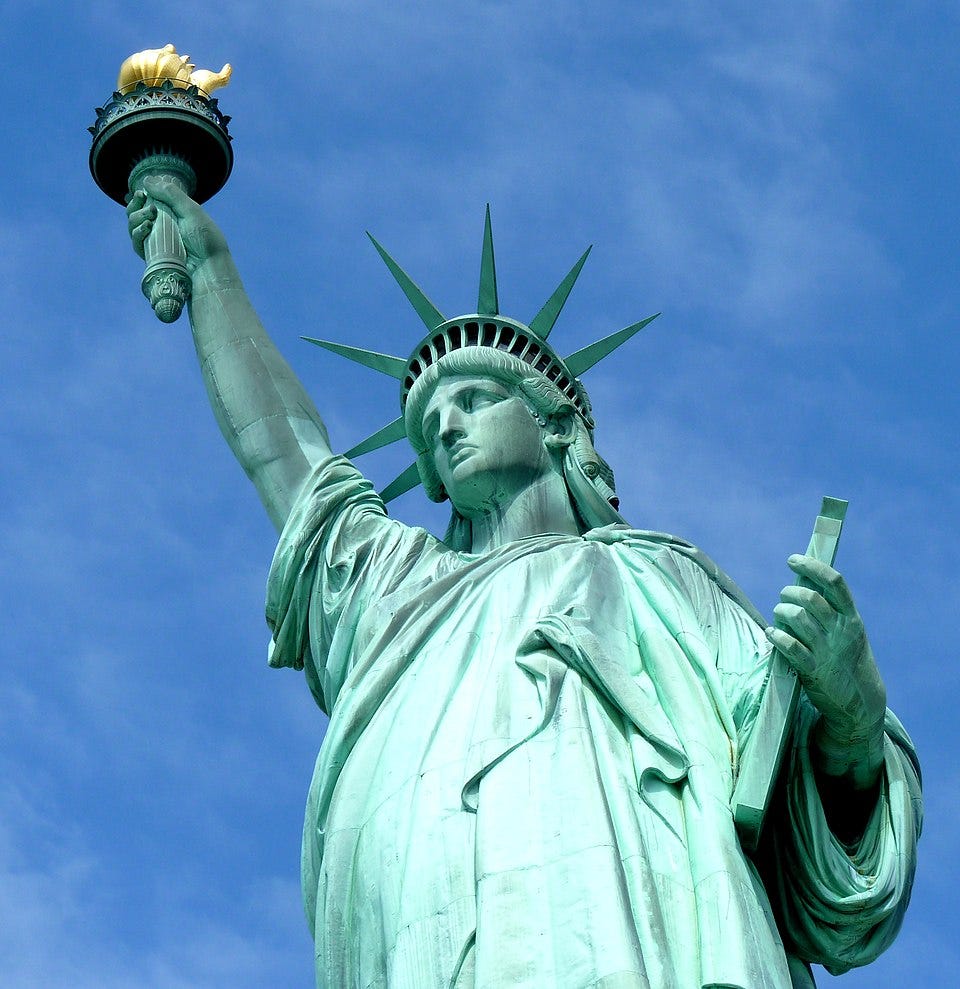

[I got home two days ago from a visit with family in central Mexico. This is my attempt to say what I couldn’t say clearly enough while I was still standing in front of them.]
To those of us who may have forgotten why the world used to respect us:
As is always the case when I go to Mexico, everyone was kind to me. Like, pointedly kind … in a way that felt like a gift I didn’t entirely deserve, given the state of the country from which I hail. But again and again, people found me in the middle of afternoon meals or sitting on the patio in the evening and asked some version of the same question:
“How did this happen to the United States? How did y’all allow what’s going on?”
Let me be quick to say, they weren’t throwing accusations; they were genuinely baffled. But underneath the bewilderment was something harder to sit with.
It felt like … disappointment.
The thing people kept bringing up?
They said they’d always respected the idea that you could go to the United States, work hard, raise your kids, and over time, your family would be accepted as Americans. Not with an asterisk. Not provisional. Just Americans. (Note: I’m aware of the distinction between “US citizens” and “Americans,” because Americans are actually anyone from North, Central, or South America. I’m simply employing my family’s terminology: “los Americanos.”)
“That doesn’t happen here,” my cousin told me.
Turns out, in Mexico, people don’t easily stop being from someplace else. Even after decades in Mexico City, for instance, a family from Oaxaca or Canada might still be seen, by themselves or by their neighbors, as Oaxacan or Canadian in important ways. And even when they get to the point where they don’t understand themselves that way any longer, their neighbors often still will.
And the thing is, my cousin wasn’t complaining. In fact, he was pointing out what he saw as something genuinely different about the United States, a version of belonging not locked to blood or soil.
“But now...” he said. And stopped.
He didn’t need to finish. What else is he going to say? He didn’t want to risk offending me, I’m sure.
And frankly, I don’t think their disappointment in us is naïve. It feels more like the disappointment of people who saw something real in who we aspired to be, even when the reality kept falling abysmally short.
The welcome mat was always conditional, and they knew it. But there was at least a stated commitment, written into the founding documents and marched for in the streets. We said that part of what makes us the people we are is that we agreed, at least in theory, that the circle was supposed to keep getting bigger.
So, what’s being dismantled now in this country isn’t just policy, but the original aspiration itself.
And as much as I’d like to blame the “other side,” I know I’m wrapped up in the whole mess in ways that are often too easy to hide from myself.
I grew up in a version of America where the question “Are you really American?” was never something I had to worry about. I’d have been gobsmacked if somebody’d asked me. But even though it never occurred to me to think about it explicitly, I’ve lived most of my life with the quiet confidence of the person who’s never had to prove they belong. Just took it for granted.
But what I didn’t notice for a long time was how much of my own comfort depended on other people being kept behind the rope line, denied entry to the club.
So when people in Mexico ask me, “How did you let this happen?” what am I supposed to say? I don’t have a simple answer. I figured out pretty quickly that something was turning sour in the cultural vegetable crisper.
So, I wrote, I protested, and I even ran for office. But I also just kept living my life, sitting by while the machinery was being built that got us into this mess.
I’m not innocent, okay? None of us who had the ability to look away because we could get to claim innocence now.
Here’s what I keep coming back to, though:
The broken promise that belonging doesn’t require a bloodline and that a stranger can become a neighbor isn’t just an American notion. It’s in the book.
It runs through the Torah like a spine. “You shall love the stranger as yourself, for you were strangers in the land of Egypt.” It appears in some form around thirty-six times in the Hebrew scriptures, more than almost any other commandment, including the command to love God.
To a certain extent, US policy aspirations about welcoming everyone else’s “tired, their poor, yearning to breathe free” borrowed that vision without giving God credit for it. And now, in a delicious twist of irony, some of the people most loudly claiming to speak for God are the same ones most actively working to dismantle not only the apparatus of hospitality to strangers, but even the empathic impulse behind it.
But that’s the thing about false gods: they can’t support the weight of what we ask them to bear on their hollow shoulders. Which means that what we’re watching isn’t just a political dumpster fire, but the collapse of an idol.
So, the fact that so many people are grieving right now, not just angry but actually grieving, means that people are tuned in. Because the presence of grief means we’ve lost something real.
If you’re one of the people who’ve made that journey and were welcomed, or thought you would be, and now find yourself being told your belonging was always provisional, I want to suggest that it meant something to believe in our offer of welcome. That promise was pointing somewhere worth going. Most of us know that the people working to destroy that promise of hospitality aren’t the last word on what this country is capable of being.
Neither are they the last word on what God is doing in the world.
I got on that plane home carrying this much, at least: the shame of knowing that people outside this country still believed in a version of us that too many inside have been busy trying to kill.
And maybe that’s the clearest way I know to say it now: what’s at stake isn’t just policy. It’s whether we still believe a human being can belong without having to prove they were born from the right people, in the right place, under the right flag.
We’ve never really kept that promise the way we’ve tended to idealize it. But that promise was holy anyway, a heritage we should never back away from or apologize for.
And if we let the fearful and the cruel destroy that promise now, then we won’t just have betrayed our neighbors. We’ll have betrayed one of the few genuinely decent things we ever dared to say about ourselves.
May God save us from that.
And may God make us the kind of people the stranger was right to trust in the first place.
Be gentle and brave,
Derek
Derek. Excellent piece. The question your cousin asked is asked to Americans around the world. They ask it not in anger but confusion and compassion. Essentially, they are worried about us, the stranger in a foreign land. Thanks for sharing your thoughts, hopes and prayers.
A much needed sobering reminder of a promise that needs to be restored. Thank you Derek.